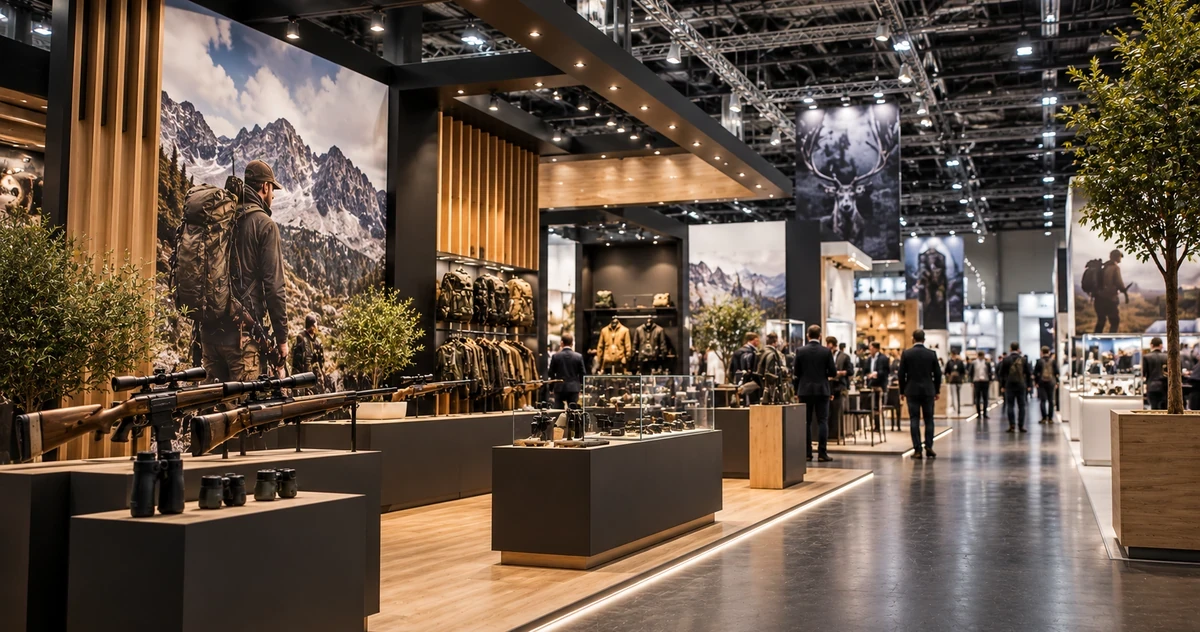
IWA OutdoorClassics is held every year at the Exhibition Centre Nuremberg and is one of the main international meeting points for its sector. For exhibitors coming from outside Germany, it is also a good example of how a German trade fair differs from a US one. The rules are written down, they are specific, and they are enforced. Very little is left to negotiation on site.
That is useful if you plan for it and expensive if you do not. Stand plans have approval deadlines. Materials need fire certificates. Powered handling in the halls is reserved for a designated forwarder. Several mandatory fees sit on top of the price per square metre.
This guide covers what an exhibitor needs to understand before committing: what the fair is, how stand types and pricing work, what the technical regulations require of your design, how logistics operate on site, and what international exhibitors need to prepare. Specific dates, rates and deadlines change each year, so they are collected in one section near the end.
What the fair is, and where it stands today
The fair is organised by NürnbergMesse and is strictly trade-only. It is not open to the public on any day, admission is limited to over-18s, and trade visitors need proof of trade status when they register. Direct sale of goods at stands is not permitted.
The most recent edition, in 2026, recorded 1,050 exhibitors from 49 countries, with roughly 83 percent of exhibitors coming from outside Germany, and more than 25,000 trade visitors. For context, the 2019 edition, the last before the pandemic, reported more than 1,600 exhibitors and about 45,500 trade visitors. Numbers have recovered from the 2022 restart but have not returned to that level.
That matters for planning. A fair of this size and international mix rewards focused objectives: meetings with distributors and importers, introductions to new regional markets, and visibility with international buyers. It rewards those better than a general presence, and your stand should be designed around the objective you actually have.
The fair spreads across several halls, which are organised by product category. Where your category sits determines which hall you are in, and that matters for design, because the technical limits are hall-specific, as covered below.
How booking and stand types work
Returning exhibitors re-book through their personal login in the exhibitor portal. New exhibitors submit a contact form and are contacted by the organiser's sales team. Eligibility is limited to companies operating in the sector, such as manufacturers, wholesalers, importers, exporters and distributors.
German trade fairs use a standard vocabulary for stand types, and the price rises with the number of open sides:
| German term | English equivalent | Open sides |
|---|---|---|
| Reihenstand | Row or inline stand | One |
| Eckstand | Corner stand | Two |
| Kopfstand | Peninsula or end stand | Three |
| Blockstand | Island or block stand | Four |
The organiser assigns the stand type according to the hall layout, and the published terms state that there is no claim to a specific type. The published booking information focuses on stand type and hall layout rather than a points ladder of the kind used at some US shows. How placement within a hall is decided is a question worth putting to the sales team directly, early.
Exhibitors choose between bare floor space and a complete system stand supplied by the organiser. The system option can be configured online and is positioned as the cost-effective alternative to a custom build. For a first-time exhibitor with a modest footprint, it is worth pricing both before assuming a custom stand is necessary. For larger or brand-critical presences, a custom structure remains the usual route. The trade-offs are set out in our guide to custom vs modular exhibition stands.
What the technical regulations mean for your design
Messe Nürnberg publishes technical regulations that apply to every stand, and a per-hall data sheet that sets the physical limits. The points below reflect the most recent regulations we reviewed, and you should confirm them against the current edition.
Height
The maximum height for a single-storey stand is 6.0 metres across the fair, but the regulations themselves note that this cannot be built in every hall because of the building structure. Ceiling heights in most halls are lower than that, and only the taller halls allow substantially higher structures. Confirm your hall before the design is fixed. A concept developed at 6 metres may simply not fit.
Plan approval
Single-storey stands up to 400 square metres do not need to submit plans, provided the technical regulations are followed. Above that size, and for all special constructions, plans must be approved by the organiser's event engineering team.
Two-storey stands
These are possible only with organiser approval and only in certain halls. They require a verified structural analysis, a full materials specification with fire certificates, detailed drawings and an escape route plan. Plans are due at least six weeks before set-up, and review can take considerably longer than that in practice. Treat a double-deck design as a project with its own critical path, not as a design option added late.
Fire safety
Construction, decoration and textile materials must meet the B1 flame-retardant standard (DIN 4102-1), or the equivalent European classification, with test certificates available on the stand. Ceilings must be open, with only a limited share of the area closed. A contiguous closed area above a certain size brings sprinkler or detector requirements. Certain thermoplastics, including expanded polystyrene and PVC, are not permitted. A design that specifies the wrong material is a design that has to be rebuilt.
Sightlines and boundaries
Sides of the stand that face an aisle must be open, and solid walls are limited to a proportion of the side length. Rear and dividing walls above a defined height that face a neighbour must be finished in a light, neutral colour and kept free of installations. This is a very common reason for late design changes.
Rigging and suspension
Rigging is exclusive to the organiser through its appointed service partner, and the permitted load per suspension point varies sharply between halls. Chain hoists are allowed only in some halls.
Sustainability
NürnbergMesse runs on certified green electricity, uses recyclable carpet as standard on rental stands, and sorts waste at a high rate. This sits within the German trade fair industry's commitment to climate neutrality by 2040, which is also what the mandatory industry association fee is tied to. Reusable stand construction is increasingly part of that picture, and a design built for reuse is better aligned with where the industry is heading.
Logistics: how it differs from the US model
For exhibitors used to US shows, the labour model is the biggest difference. There is no union jurisdiction system, and you can build your own stand and carry your own light materials. But powered handling in the halls, meaning forklifts and cranes, is carried out exclusively by the resident forwarder. Outside forwarding crews cannot be brought in for in-hall handling, and empty packaging cannot be stored on your stand. Storage is ordered through the service partner at additional cost.
Vehicle access is managed through a digital slot booking system. Vehicles must pre-book a delivery slot by length category, the largest category requires a mandatory forklift booking, and same-day bookings carry higher fees. Arriving without a slot is not a workable plan.
Build-up and dismantle run on defined schedules. Exhibitors with their own stand construction build over the several days before opening, and rental stand exhibitors start slightly later. Dismantling begins only after the fair closes. Early teardown before the official close is penalised heavily, with a charge calculated on the stand rental and potential exclusion from the next edition. Staff must be present until the end, so travel plans and return freight should be scheduled accordingly.
Waste disposal is a mandatory per-square-metre charge, separate from any removal of your own construction materials.
Accommodation is tight during fair week. Nuremberg's hotel supply is limited relative to demand, and the organiser runs an official partner hotel portal. Booking late pushes staff to outlying towns and raises costs.
How the budget actually builds
The price per square metre is the visible number. The total is made up of several layers:
| Layer | What it covers |
|---|---|
| Stand rental | Price per square metre by stand type, subject to a minimum rental |
| Mandatory fees | Industry association fee and per-square-metre waste disposal charge |
| Marketing package | Compulsory entry in the official listings and related services |
| Utilities | Electricity, water and compressed air, ordered in advance at lower rates |
| Rigging and handling | Exclusive provider for rigging; resident forwarder for powered handling |
| Vehicle slots | Delivery slot by length category, with surcharges for same-day booking |
| German VAT | Applied on top, generally reclaimable by foreign exhibitors |
Exhibitors who budget from the headline rate alone find the final figure materially higher. Build the budget bottom-up from the exhibitor price list rather than from a per-square-metre estimate.
Notes for international exhibitors
Customs. For exhibitors outside the EU, an ATA Carnet is the usual route for temporarily importing stand materials, equipment and samples without duties. Carnet validity and the treatment of exhibition goods should be confirmed with the issuing chamber. Consumables and giveaways that stay in the EU are generally not covered. Display and handling of regulated goods carries additional German and EU rules, and exhibitors must consult the official exhibitor documentation for those. Your freight forwarder or customs broker should manage the method.
Visas. Staff from countries that require a Schengen visa, which includes Turkey, need a business visa applied for through the responsible German mission. Processing typically takes around fifteen working days and can be longer in peak periods, so apply well ahead of travel. The organiser can issue invitation letters. Exhibitors from visa-exempt countries, including US nationals for short stays, have fewer constraints.
VAT. German VAT applies to stand and service costs, and foreign exhibitors can generally reclaim it through the German refund procedure. Build the timing into cash flow planning and confirm the procedure with a tax adviser.
Support programmes. Government export promotion schemes may cover part of the cost of participation. For Turkish companies, support through the Ministry of Trade and related bodies exists for overseas fair participation, and its scope and caps should be checked directly with the relevant institution. US companies can use the services of the US Commercial Service.
IWA and SHOT Show: planning for both
Many exhibitors attend both fairs, which fall about a month apart, with SHOT Show in January and IWA in late winter. The audiences differ. SHOT Show is dominated by the US market and its buying cycle, and the allocation and logistics model there works very differently, as set out in our SHOT Show exhibitor guide. IWA is European and genuinely international, with a large majority of exhibitors from outside Germany.
For stand strategy, that means different priorities. At IWA, budget specifically for European compliance: fire-certified materials, structural approval for any two-storey element, exclusive rigging and handling. Treat it as a market to build distributor relationships in. And think about launch timing across the two fairs rather than spending all of it at the first.
A structure designed once and reconfigured for both fairs is a realistic option, provided the design is checked against the stricter of the two rule sets from the start. Working through that with a partner experienced in exhibition stand design and build for European trade fairs is more useful before the design is fixed than after.
What to verify each year
The following change annually. Confirm them in the exhibitor portal and the current technical regulations rather than relying on any figure printed here:
- Fair dates and build-up and dismantle schedules, including any announced schedule changes
- Price per square metre by stand type, and the minimum stand rental
- Mandatory fees: industry association fee, waste disposal, marketing package
- Technical regulations and the hall data sheet for your specific hall
- Plan submission deadlines for large and two-storey stands
- Advance order deadlines and surcharges for utilities and services
- Named service partners and forwarders for the edition
- Vehicle slot categories and fees
- Official hotel booking portal and rates
For reference, the published 2027 edition rates ran from EUR 211 per square metre for a row stand to EUR 265 for a block stand, with a minimum rental of EUR 2,530, before the mandatory fees and VAT. These are edition-specific and will change.
Frequently asked questions
How do stand types and pricing work at IWA OutdoorClassics?
German trade fairs price by the number of open sides. A Reihenstand (row or inline stand) has one open side, an Eckstand (corner stand) two, a Kopfstand (peninsula or end stand) three, and a Blockstand (island or block stand) four, with the price rising accordingly. The organiser assigns the stand type according to the hall layout, and the published terms state there is no claim to a specific type.
What do the Messe Nürnberg technical regulations require?
The maximum height for a single-storey stand is 6.0 metres across the fair, but most halls have lower ceilings, so the hall data sheet governs. Single-storey stands up to 400 square metres do not need to submit plans if the regulations are followed; above that, and for all special constructions, plans need approval. Construction, decoration and textile materials must meet the B1 flame-retardant standard (DIN 4102-1) with certificates available on the stand, and aisle-facing sides must stay open.
Can I use my own crew to handle freight in the halls?
You can build your own stand and carry your own light materials, as there is no union jurisdiction system of the kind found at US shows. But powered handling in the halls, meaning forklifts and cranes, is carried out exclusively by the resident forwarder. Outside forwarding crews cannot be brought in for in-hall handling, and empty packaging cannot be stored on your stand. Vehicle access runs through a digital slot booking system.
What goes into an IWA stand budget beyond the price per square metre?
The headline rate is only the stand rental. On top of it sit the mandatory industry association fee, the mandatory waste disposal charge, the marketing package, electricity, water and compressed air, rigging, handling and vehicle slot fees, and German VAT. Build the budget bottom-up from the exhibitor price list rather than from a per-square-metre estimate.
What do exhibitors travelling from outside the EU need to arrange?
An ATA Carnet is the usual route for temporarily importing stand materials, equipment and samples without duties, though consumables and giveaways that stay in the EU are generally not covered. Staff from countries that require a Schengen visa, which includes Turkey, need a business visa through the responsible German mission, typically around fifteen working days and longer in peak periods. German VAT applies to stand and service costs and can generally be reclaimed through the German refund procedure.
The takeaway
IWA rewards preparation more than flexibility. The rules are written, the deadlines are real, and the handling model leaves little room for improvisation on site.
For a first-time exhibitor, the practical priorities are straightforward. Confirm your hall before finalising the design, because height and rigging limits depend on it. Specify fire-certified materials from the start. If you are building a double deck, start the approval process months before you think you need to. Budget from the full price list, not the headline rate. And if your staff need a Schengen visa, apply early.