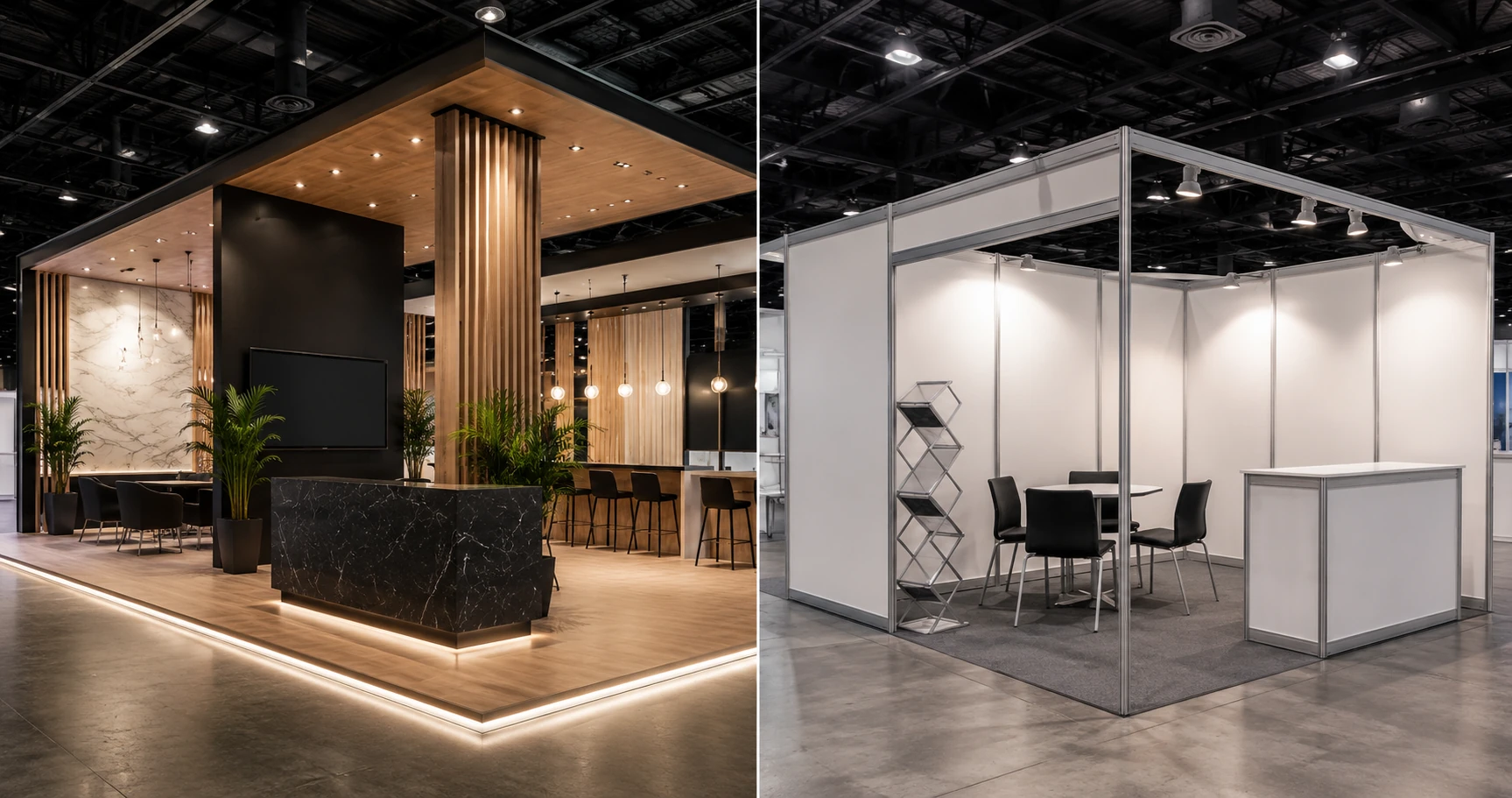
Most articles on this subject treat custom versus modular as a design debate. Do you want something unique, or something practical? Framed that way, the answer is obvious and useless, because everyone wants both.
The debate is misplaced. Modern system-based stands can deliver curved walls, full-bleed graphics with almost no visible frame, integrated LED surfaces and bespoke finishes. The visual gap that justified this argument fifteen years ago has largely closed.
What has not changed is the underlying economics. Custom and modular have genuinely different cost structures, different logistics profiles and different break-even points. The decision is a business decision about how often you exhibit, how much your structure weighs, how much your footprint varies and whether you want an asset on your balance sheet or a line in your event budget.
This guide sets out how to make that decision on the right variables.
What the two approaches actually are
Custom builds are designed and fabricated from scratch for a specific brief and footprint, typically in timber, MDF, steel, glass or acrylic. There are no system constraints. The structure is yours, and so is the design.
Modular or system-based builds use reusable aluminium extrusion frames and interchangeable components that reconfigure between shows. The established systems each use their own proprietary connector and frame geometry, and components generally are not cross-compatible between manufacturers. Graphics attach either as rigid panels or as silicone-edge tension fabric, which is what allows a modular stand to present a nearly seamless printed surface.
Hybrid builds combine a custom core, often meeting rooms, counters and feature elements, with a modular perimeter that reconfigures as the footprint changes.
Rental removes ownership entirely. You hire a structure per show, custom-look or system-based, and it goes back afterwards.
Four options, not two. The framing that pits custom against modular tends to hide the two that suit many exhibitors better.
The variable that decides most cases: how often you exhibit
Ownership only makes sense if the asset gets used enough times to beat repeated rental.
Industry practitioners commonly cite a rough guideline that a single rental costs somewhere around a third of the cost of owning a comparable exhibit. Working from that, the break-even for owning a mid-size structure typically lands somewhere in the range of three to four shows a year, though some exhibit houses argue it is closer to five or six once storage, refurbishment and per-show logistics are fully loaded into the calculation.
The exact number matters less than the method. Compare total cost of ownership divided by the number of shows the structure will actually serve against the per-show rental cost. Most exhibitors instead compare a build quote against a single rental invoice, which is not the same calculation and reliably produces the wrong answer.
Two things people leave out of the ownership side:
Owned structures need storage between shows, and they need periodic refurbishment. A stand also has a design lifespan. Most owned exhibits get a meaningful redesign every three to five years, either because the brand changes or because the structure starts to look dated next to newer neighbours. If the asset is retired after three years, it has to have earned its cost in those three years.
Weight is a recurring cost, not a one-time one
This is the part of the comparison that gets least attention and matters most for anyone exhibiting in the United States.
At US shows, moving your freight from the dock or advance warehouse to your space, storing the empty crates and bringing them back at breakdown is billed as material handling, commonly called drayage. It is charged by weight in hundredweight units, it is charged by the show's official contractor rather than your stand builder, and it is charged in both directions. This is one of several line items covered in more depth in our guide to what a trade show booth costs in the USA.
Published guidance from logistics providers puts rates in a broad range depending on the show and the delivery route, with direct-to-show-site shipments priced higher than advance warehouse deliveries. The precise rate varies by venue, city and year, so treat any single figure with caution and check the exhibitor service kit for your specific show. What is consistent is the mechanism: heavier structure, higher bill, every single show.
Aluminium system frames are substantially lighter than equivalent timber and MDF construction. Logistics providers advising exhibitors on cost reduction routinely list switching to lightweight modular systems as one of the largest available savings on this line, alongside shipping to the advance warehouse rather than direct to site. Manufacturers publish specific per-frame weights, and some explicitly market the drayage saving as a benefit, so treat the more dramatic timber-versus-aluminium comparisons as vendor claims rather than independent findings. The directional point is well established even if the exact multiple is not: weight converts directly into recurring freight and handling cost.
Europe works differently. There is generally no drayage equivalent at European shows, where handling your own stand materials is not a chargeable service billed by the organiser. If your show calendar is entirely European, weight matters for freight but not for this particular line, which shifts the calculation.
Labour, build windows and what you are allowed to do yourself
At major US convention centres, installation and dismantle work often falls under union jurisdictions, with separate trades for carpentry, electrical, rigging and freight handling. Crews are assigned by trade rather than by familiarity with your specific structure, which means a complex custom build is being assembled by people seeing it for the first time. Venues also restrict what exhibitor staff may do themselves, and assumptions here are a common source of cost surprises.
Modular systems assemble faster and more predictably, often with tool-free connectors, which reduces labour hours and reduces the risk of the build running into premium-rate evening hours. On a narrow move-in schedule, this is not a convenience issue. It is a cost and risk issue.
Lead times differ sharply as well. Custom projects run on a months-long cycle covering concept, engineering, fabrication and graphics. Modular structures can be turned around in weeks, because the structural components already exist in a warehouse and only the layout and graphics change.
| Dimension | Custom build | Modular / system build |
|---|---|---|
| Up-front cost | Higher; design absorbed into a single project | Lower per show once components are owned |
| Weight and drayage | Heavier timber and MDF construction, recurring cost at every US show | Lighter aluminium frames, materially lower handling bills |
| Install and dismantle | Longer, more labour hours, higher risk of premium-rate hours | Faster, often tool-free, more predictable on a narrow window |
| Lead time | Months: concept, engineering, fabrication, graphics | Weeks: components exist, layout and graphics change |
| Footprint flexibility | Optimised for one footprint; hard to adapt | Reconfigures across different sizes and shows |
| Design freedom | Unlimited: sculptural forms, double decks, heavy product mounting | Constrained by grid and connector geometry |
| Best fit | Flagship shows, radical architecture, low show frequency with high impact | Multi-show calendars, varying footprints, US-heavy schedules |
Where custom is still the only real option
The claim that modular can now do everything is overstated. Genuine custom territory remains:
Double-deck structures
The structural and engineering requirements of a two-storey stand, including stairs, load ratings, permits and egress, generally exceed what system components are designed for.
Very large footprints
Above a certain scale, the cost advantage of lightweight system components narrows and bespoke construction becomes more sensible.
Heavy product display
Mounting machinery, vehicles or heavy equipment brings load requirements that standard frames are not engineered to carry.
Radical architecture
Sculptural forms, unusual geometry and materials chosen for a specific brand language sit outside what any grid-based system can produce.
If none of these describe your requirement, the design-freedom argument for custom is weaker than it is usually presented.
Sustainability is becoming a procurement condition, not a preference
In Germany and across the EU this has moved from marketing language to tender criteria. The German trade fair industry has adopted industry-wide environmental standards with a stated goal of climate neutrality by 2040, and stand construction guidance focuses explicitly on reuse and recycling. Separately, the Better Stands programme, which originated with Informa and is now run under Net Zero Carbon Events with support from UFI and IFES, rates stands on a tiered scale from single-use upward, with the explicit aim of moving the industry away from disposable builds.
The important nuance, and the one most content on this subject gets wrong, is that modular is not automatically the sustainable choice. A well-engineered custom structure designed to be reused across several shows performs well. A modular system bought and used once does not. The variable that matters is reuse, not construction method.
If you are exhibiting into markets where sustainability credentials affect procurement, certifications carry more weight than claims. FSC or PEFC for timber chain of custody, ISO 14001 for environmental management and ISO 20121 for sustainable event management are audited rather than self-declared.
Regional differences worth accounting for
The same decision does not resolve the same way in every market.
| Market | What changes |
|---|---|
| United States | Booth is the standard term, the base unit is a ten by ten foot space, and cost is dominated by drayage and union labour rather than build price. Large custom island exhibits are common at flagship shows. |
| Europe | Stand is the standard term and the base unit is three by three metres. Exhibitors choose between a shell scheme, where the organiser supplies a hard-walled framework, and space-only, where you build freely to a greater height. There is no drayage regime and no equivalent union structure. |
| Middle East | Custom-heavy, with premium finishes and a strong emphasis on visual impact at shows such as GITEX Global, Arab Health and The Big 5. |
If your show calendar spans several of these markets, a single structure has to satisfy the strictest of them, and that constraint should be in the brief from the start.
A checklist for the decision
Work through these before choosing an approach:
- How many shows per year, and for how many years ahead is that realistic?
- How many different footprint sizes across that calendar?
- Is this budgeted as a capital asset or a per-show operating expense?
- What proportion of shows are in the US, where weight carries a recurring cost?
- Do you have storage, or would you be paying a contractor to hold it?
- Does the design require a double deck, heavy product mounting or unusual geometry?
- How tight is the move-in window at your largest show?
- Does any target market apply sustainability criteria to exhibitor selection?
- How long before a rebrand or repositioning would make the structure obsolete?
- Is one flagship show carrying disproportionate weight, justifying a different approach there than elsewhere?
If the answers point in different directions, that is usually a signal that a hybrid approach fits: a reusable core for the regular calendar, scaled up with rental or custom elements for the one or two shows that matter most.
Working through these constraints with a builder early, before the design is fixed, is more productive than collecting quotes on a brief that has not resolved them. This is the stage where exhibition stand design and fabrication decisions still cost nothing to change.
Frequently asked questions
Is a custom or a modular exhibition stand cheaper?
Neither is cheaper in the abstract. Custom carries a higher up-front build cost but can be amortised across several shows if it is engineered for reuse. Modular lowers freight, labour and reconfiguration cost per show but constrains the shape of the design. The honest comparison is total cost of ownership divided by the number of shows the structure will actually serve, measured against the per-show rental cost.
How many shows a year justify owning an exhibition stand?
Practitioners commonly cite a rough guideline that a single rental costs around a third of owning a comparable exhibit, which puts the break-even for a mid-size structure somewhere in the range of three to four shows a year. Some exhibit houses argue it is closer to five or six once storage, refurbishment and per-show logistics are fully loaded in. The method matters more than the number.
Why does stand weight matter so much for US trade shows?
At US shows, material handling, commonly called drayage, is billed by weight in hundredweight units, charged by the show's official contractor, and charged in both directions. Aluminium system frames are substantially lighter than equivalent timber and MDF construction, so weight converts directly into a recurring freight and handling cost at every single show. European shows generally have no drayage equivalent, which shifts the calculation.
Is modular automatically the more sustainable option?
No. The variable that matters is reuse, not construction method. A well-engineered custom structure designed to be reused across several shows performs well, while a modular system bought and used once does not. In markets where sustainability affects procurement, audited certifications such as FSC or PEFC, ISO 14001 and ISO 20121 carry more weight than claims.
When is a custom build the only real option?
Double-deck structures, very large footprints, heavy product display such as machinery or vehicles, and radical sculptural architecture all sit outside what grid-based system components are engineered for. If none of these describe your requirement, the design-freedom argument for custom is weaker than it is usually presented.
The takeaway
Custom versus modular is not a question about how your stand will look. Premium system-based builds can look bespoke, and custom builds can be engineered for reuse.
It is a question about frequency, weight, variability and time horizon. Exhibitors who answer those four questions honestly usually find the decision makes itself, and they stop paying for flexibility they do not use or losing money on an asset that does not get used enough.