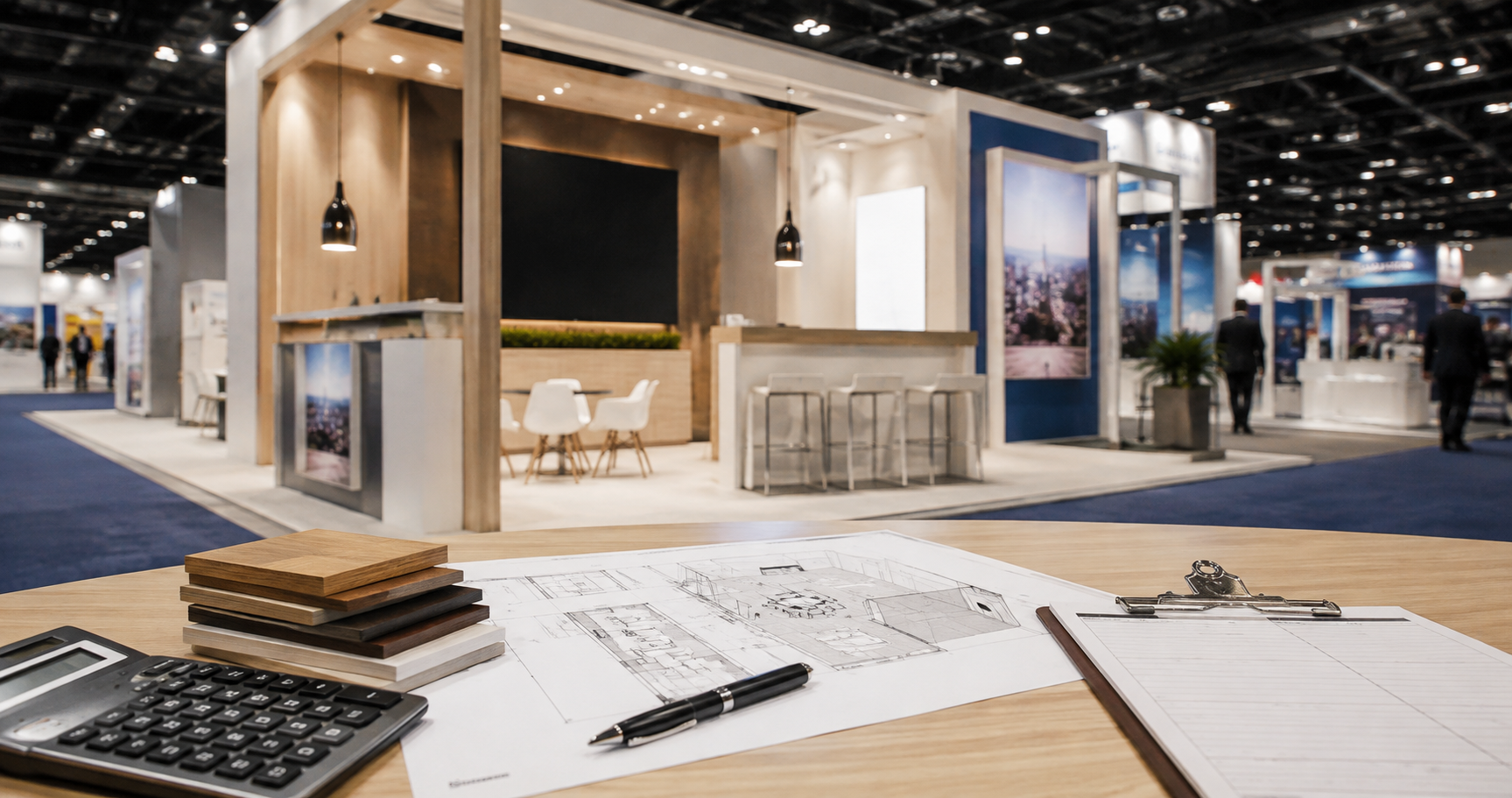
Ask ten exhibitors what a trade show booth costs in the United States and you will get ten different answers. That is not evasion. It is an accurate reflection of how the pricing works. A booth is not a product with a shelf price. It is a bundle of separate contracts, deadlines, and venue rules, and the same design can carry very different costs depending on the city, the show, and how early the decisions were made.
If you are exhibiting in the US for the first time, particularly if you are coming from outside North America, the most expensive mistake is not choosing the wrong builder. It is building a budget around the wrong categories and discovering the missing ones after the invoices arrive.
This guide breaks down what actually goes into the number, and what makes it move.
Why "cost per square foot" is a misleading starting point
Cost per square foot is the most requested figure in exhibition planning and the least useful one in isolation. The reason is simple: it describes an average across items that scale very differently.
Floor space rental scales almost perfectly with area. Double the square footage and you roughly double that line. Structural fabrication does not behave the same way, because a larger footprint often means a different structural approach entirely, not simply more of the same. Meanwhile, some of the largest cost drivers, such as show services and labor, are tied to hours, connection points, and union rules rather than to area at all.
Two exhibitors can take identical footprints at the same show and land at very different totals because one built a lightweight modular structure shipped from a domestic warehouse and the other built a custom double-deck flown in from overseas with a tight installation window.
A per-square-foot number is useful only as a sanity check late in the process, after the actual scope is known. It is not a planning tool at the start.
The cost categories behind a US trade show booth
A complete budget usually spans the following categories. Missing any of them is where overruns come from.
1. Exhibit space rental
Paid directly to the show organizer, not the stand builder. Rates are set per square foot and vary by show, and often within a single show by location on the floor. Corner, peninsula, and island positions typically carry premiums over inline space, and high-traffic aisles or positions near main entrances are priced accordingly.
Space rental is also the deadline that governs everything else. Booth location assignments frequently follow a priority points system based on past participation and booking date, which is why the exhibitors with the best positions are usually the ones who committed earliest.
2. Design and fabrication
This is the visible part: structure, flooring, walls, storage rooms, meeting areas, counters, lighting rigs, custom joinery, and finishes.
The decision that moves this line most is the build approach. Custom builds are made for a specific footprint and brief, and the design cost is absorbed into a single project. Modular and system-based builds use reconfigurable components, which lowers the cost of a repeat show but constrains the shape of the design. Rental structures shift the cost profile again, trading ownership for a per-show fee.
None of these is universally cheaper. A custom structure used across four shows in three years can cost less per appearance than four separate rentals. A rental can be the better call for a single, one-off market test.
3. Graphics, print, and branding elements
Large-format prints, tension fabric, backlit panels, vinyl, and dimensional signage. This line is sensitive to material choice and to how many times the graphics can be reused. Show-specific messaging or dated content makes reuse impossible, which is a common and avoidable cost.
4. Freight and international shipping
For exhibitors shipping into the US, this includes ocean or air freight, customs clearance, and often a customs bond or ATA Carnet depending on how the goods are entered. Air freight offers speed and schedule certainty at a significant premium. Sea freight is far more economical but demands a materially earlier production deadline, which means the design has to be locked earlier too.
5. Drayage, or material handling
Drayage is the single most underestimated line item for exhibitors new to the US market. It covers moving your freight from the loading dock or advance warehouse to your booth space, storing empty crates during the show, and returning them at breakdown.
It is billed by weight, typically in hundredweight units, with minimums applied. It is charged by the show's official general contractor, not by your builder, and it is usually not negotiable. Two factors drive it: total shipment weight and whether the freight arrives at the advance warehouse or direct to show site, each priced differently and each with its own deadline. Late arrivals, off-target deliveries, and uncrated shipments all attract surcharges.
Heavier structures cost more to move, which is why material selection has a cost consequence well beyond the fabrication invoice.
6. Installation and dismantle
Labor to build and break down the booth. In much of the US, and particularly in major convention cities, this work falls under union jurisdictions with defined trade boundaries. Carpentry, electrical, rigging, and freight handling can each be separate crafts with separate rates.
Rates change with the clock. Work outside standard hours moves to overtime or double time, and breakdown almost always runs into premium hours. Setup schedules with narrow windows push more of the work into those hours, which is a design consideration, not just a scheduling one. A structure engineered for fast assembly reduces labor exposure directly.
Venues vary in what exhibitor personnel are permitted to do themselves. Assuming your own team can handle the build is a common and costly misreading of the rules.
7. Show services from the official contractor
Ordered through the exhibitor service kit, and this is where deadlines convert directly into money. Electrical service and distribution, rigging for hanging signs, compressed air, plumbing, internet and network connections, cleaning, and furniture rental all sit here.
Advance order pricing is materially lower than floor order pricing at nearly every show. Ordering power on site, on the day, is one of the most reliable ways to inflate a budget.
8. Storage, refurbishment, and reuse
If you own the structure, it has to be stored between shows and refreshed periodically. Domestic US storage avoids repeat international freight for exhibitors who run multiple US shows a year, but it adds an ongoing line. This only makes sense above a certain show frequency, which is a calculation worth doing explicitly rather than by instinct.
9. Team, travel, and activation
Flights, accommodation in a city with surge pricing during show weeks, per diems, booth staffing, and any hospitality. Lead capture systems, demo equipment, product samples, and pre-show marketing sit alongside this.
These are not booth costs in the strict sense, but they compete for the same budget, and treating them as an afterthought distorts the whole plan.
What actually moves the number
Once the categories are on the table, a handful of variables explain most of the variance between two comparable projects.
| Variable | Why it moves the cost |
|---|---|
| Booth type and configuration | Inline, corner, peninsula, and island booths carry different space rates and different structural requirements. Island booths are open on all sides, which means every elevation is a finished elevation. Hanging signs bring rigging into scope. Double-deck structures add engineering review, permits, and often dedicated stair and egress requirements. |
| City and venue | Labor rates, drayage rates, and venue rules differ significantly between convention cities. The same booth is not the same cost in every US market. |
| Lead time | The variable exhibitors control most and manage worst. Early decisions unlock advance order pricing, sea freight, standard-hour labor scheduling, and the ability to source materials without expediting. Late decisions close each of those doors in sequence. |
| Reuse strategy | A structure designed once for a single show is an expense. A structure designed to be reconfigured across a multi-year show calendar is an asset, and the cost per appearance falls with each use. |
| Weight and material selection | Because drayage is weight-based, and because heavier structures take longer to install, material choices ripple into at least three separate lines. |
Building a budget that survives contact with reality
A workable approach is to build the budget from the categories above rather than from a single headline figure, then stress-test it.
Start with the fixed anchors: space rental and freight method, since both have hard deadlines. Establish the design scope next, because it determines weight, labor hours, and service requirements. Add show services from the exhibitor kit at advance rates and note every deadline in the same calendar you use for production milestones. Then add a contingency for the things that reliably move: overtime at dismantle, additional power, on-site changes, and freight timing.
If you are planning your first US exhibition and want to understand how these decisions compound across design, fabrication, and on-site execution, working through them with a team experienced in exhibition stand design and build for US trade shows early in the process is usually more valuable than getting quotes late. It also helps to review the venue-level rules in advance, whether that is the Las Vegas Convention Center or McCormick Place in Chicago, since those rules feed straight back into the labor and services lines.
Questions worth asking before you approve a budget
- Is this quote for fabrication only, or does it include freight, drayage, installation, and dismantle?
- What is the estimated shipping weight, and how was drayage calculated?
- Which show services are included, and at advance or floor rates?
- What are the union requirements at this venue, and how many labor hours are assumed?
- What are the deadlines for advance warehouse delivery and advance service orders?
- Is this structure reusable, and what would a second and third deployment cost?
- What happens to the schedule and the cost if the design changes after a given date?
Frequently asked questions
How much does a trade show booth cost in the USA?
There is no single figure, because a booth is a bundle of separately priced items: exhibit space rental, design and fabrication, graphics, freight, drayage, installation and dismantle labor, official show services, storage, and team travel. The final total depends far more on the city, the venue rules, the structure's weight and how early you commit than on the design itself.
Why is cost per square foot a misleading way to budget?
Because it averages items that scale very differently. Space rental scales almost perfectly with area, fabrication does not, and the largest drivers such as show services and union labor are tied to hours, connection points and venue rules rather than to area at all. A per-square-foot number is a sanity check late in the process, not a planning tool at the start.
What is drayage and why does it matter so much?
Drayage, or material handling, covers moving your freight from the loading dock or advance warehouse to your booth, storing empty crates during the show, and returning them at breakdown. It is billed by weight with minimums applied, charged by the show's official general contractor, and it is usually not negotiable. It is the single most underestimated line item for exhibitors new to the US market.
How can exhibitors reduce the final invoice?
Commit early to unlock advance order pricing and sea freight, engineer the structure for fast assembly to cut labor hours, keep weight down because drayage is weight-based, and design the build to be reconfigured across several shows so the cost per appearance falls with each use.
The takeaway
There is no single answer to what a trade show booth costs in the US, because the question bundles together a dozen independently priced decisions. What is consistent is which decisions matter: how early you commit, how the structure is engineered, how much it weighs, where it ships from, and how many times you plan to use it.
Exhibitors who treat the budget as a set of linked decisions rather than a quote to be compared usually end up with both a better stand and a smaller final invoice.